Accessibility
DreamApply is committed to providing a highly accessible platform for all users, including applicants, admissions administrators, and academic advisors. We strive to achieve high levels of accessibility in all interfaces, with a particular focus on applicant-facing interfaces, such as:
- Courses/Programmes search
- Application completion
- Application management
- Communication tools
Accessibility approach
Our approach to accessibility is deeply integrated into the development lifecycle and is guided by the following principles:
- Proactive design integration: DreamApply addresses potential accessibility concerns during the design phase of new features. We are continuously modernizing the system to align with evolving accessibility standards, carefully evaluate and select third-party frontend components.
- Core acceptance criterion: Accessibility is a fundamental criterion for any proposed update to the system, together with performance, security and data protection.
- Continuous improvement cycle: DreamApply implements a continuous process of testing, improvement and validation. This is complemented by robust feedback, reporting and analysis processes that involve direct input from end users.
- Ongoing education and training: Our team engages in continuous training and learning to stay informed about the latest advancements, evolving standards and the new capabilities of browsers and assistive technologies.
Accessibility standards
DreamApply is committed to complying with international accessibility standards to ensure usability for individuals with disabilities. We currently conform to WCAG 2.1 and 2.2 Level AA. For a full overview of our compliance efforts and testing approach, see the DreamApply Accessibility Conformance Report.
Testing and evaluation
The platform is tested with various screen reader technologies, including JAWS and NVDA, on a continuous basis. Special testing attention is given to major changes to applicant-facing interfaces.
DreamApply follows a weekly release cadence. To maintain quality, we employ an automated regression test suite, utilizing Selenium, Playwright and other technologies. This suite ensures that new releases do not negatively impact existing features, including accessibility.
Before being included in a release candidate, each update goes through a rigorous testing and approval process. The process can span several weeks and involve several rounds of testing and development iterations. We conduct both manual and exploratory testing led by our dedicated QA team and regularly employ screen readers such as NVDA for exploratory testing, as well as automated accessibility evaluation tools like wave and axe. Maintaining accessibility without regressions is a critical criterion for review and approval, alongside performance, security and data protection.
Accessible navigation
DreamApply is designed to be fully navigable using a keyboard, without the use of a mouse. Users can navigate through UI elements and content logically using only the Tab key, following a left-to-right and top-to-bottom order. The system features the Skip-to-content functionality that allows users to bypass repetitive elements, such as navigation headers and banners, and jump directly to the main content of the page.
Feedback mechanism
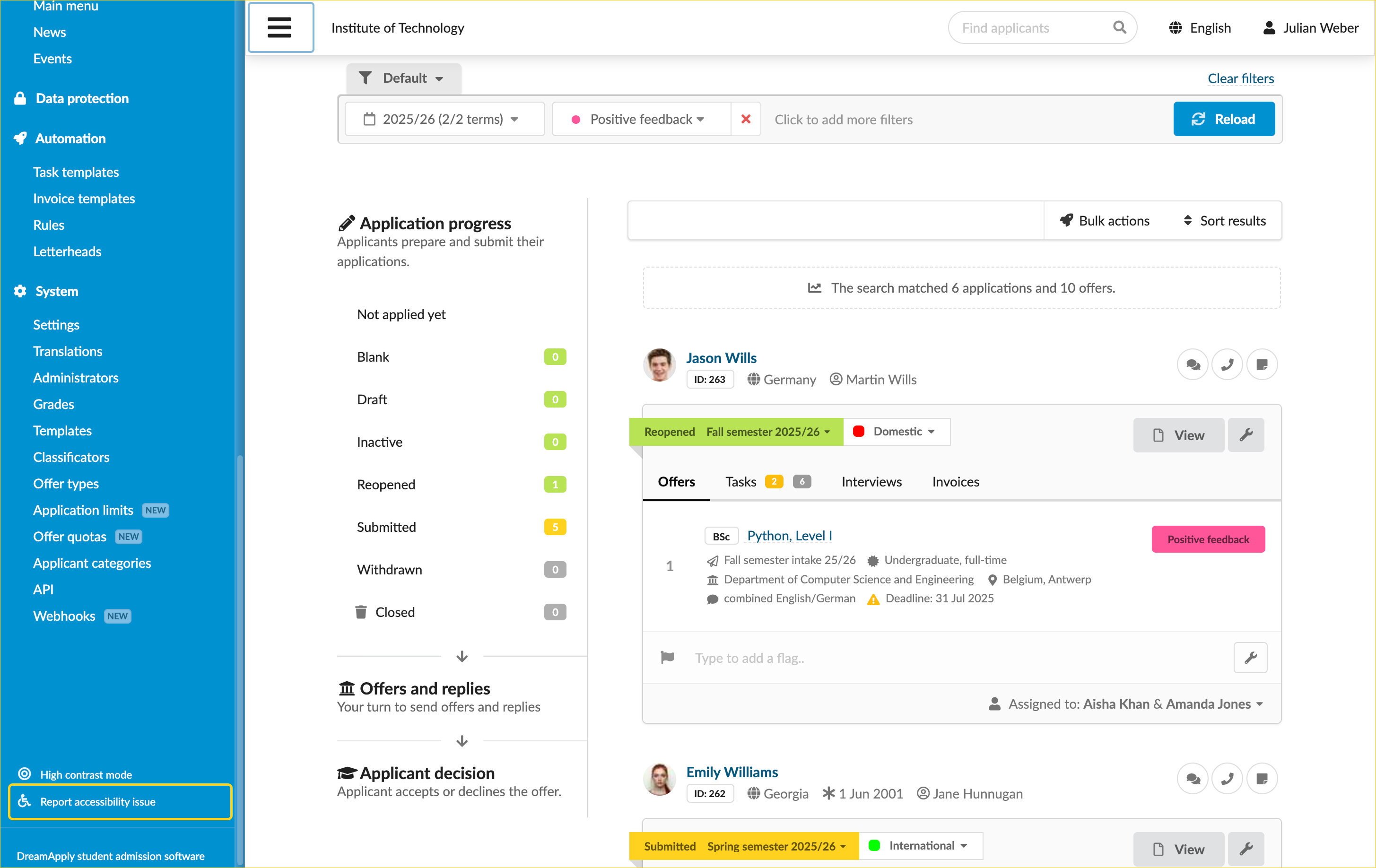
Every page in DreamApply has the Report accessibility issue link that provides a direct line of contact from end-users to our support and product management teams. The link is also available between the Skip to content and High contrast mode items when navigating the page with a keyboard.
Improvement plans
DreamApply is dedicated to the continuous improvement of our platform’s accessibility through the following ongoing efforts:
Frontend modernization: At present, DreamApply utilizes the Semantic UI front-end framework. While the current interface meets acceptable standards, it may potentially limit future improvements. We are actively in the process of replacing this framework with a more accessibility-friendly solution, allowing for greater customization of each page component to enhance future keyboard and aural interfaces. This project, initiated two years ago, is expected to be completed by Q3 2025.
As we perform these updates, we will apply accessibility criteria going beyond the minimum requirements of WCAG 2.2 Level AA compliance.
External audit : In the second half of 2025, DreamApply plans to conduct an external accessibility audit. This audit will provide an objective evaluation of our platform’s accessibility and identify any areas for improvement that may have been overlooked during our internal processes.
User feedback and reporting : We have recently implemented an accessibility reporting mechanism for end-users. This system allows users to directly report any accessibility issues encountered while using the platform.
Continuous improvement: DreamApply views accessibility as an ongoing journey rather than a singular project. We are committed to continuously evaluating and enhancing the accessibility of our platform to ensure an inclusive experience for all users.